
My review has been posted by Comment.
 This film is a creative take on the life of Bob Dylan. Dylan is played by six different characters throughout the different phases of his life and career. Christian Bale, Ben Whishaw, Heath Ledger, Richard Gere, Marcus Carl Franklin, and Cate Blanchett, each portray Dylan as a iconic figure known for his influence in music and writing lyrics. Overall the film has a sense of the mysteriousness of Dylan as a public figure who both wants to use it, but also is unsure and at times shies away from the spotlight. While the film is beautifully shot and directed by Todd Haynes, it seems aimed at the Dylan fan more than a general audience. What seems like six stories that are interconnected seems to depend on the viewer understanding the intertextuality that makes sense of the narrative and Dylan's historical influences. This narrative complexity is sophisticated, but also at times confusing. The soundtrack can't help but be great with many covers and originals of Dylan's work.
 This sequel had quite a bit to live up to. The first film (again directed by Andrew Adamson), not only had a great story to work from, but was able to keep all the essential elements and let the Christian allegory not come off as manipulative. This film has what I think is a somewhat harder story to tell, and the allegory is not completely but almost lost in the cheap shots to integrate CGI battle scenes and cheesy romance. The characters of the Pevensie children are under-developed. What is great about this book and film series is that it is suitable to a younger audience while also showing and speaking of real evil. While the books obviously focus on the development of the reader's imagination, these film adaptations show some great visuals to hopefully jump start those lacking a grand an imagination (I include myself in this latter group). For me, the film was somewhat of a disappointment.
  It took some time but I was finally able to see this much anticipated film. While 2007 seems to be the year for unexpected pregnancy films, this film takes the audience on a much more heart wrenching ride than the many others that seem to work out despite the challenges. This film is Romanian and is set in the 80's when abortion there was illegal and severely punished. The story follows two friends who live together in a crowded apartment building. When scared and naive Gabriela reveals that she is pregnant, Otilia (Anamaria Marinca) arranges for the abortion. The film shows the dedication and sacrifice that friendship involves and the difficult choices that begin to define what friendship and being in a relationship mean. The film both shows the harsh reality of the situation, as well as showing Otilia's existential questioning of what her life means and where it is headed. This is probably the one film about unwanted pregnancy this year that takes it deadly serious.
 Director Ang Lee (Brokeback Mountain) and screen-writer James Schamus (The Ice Storm, The Wedding Banquet, Eat Drink Man Woman) team up once again to adapt this short story by Chinese author Eileen Chang. To over simplify, or rather to make an unnuanced comparison, this film is similar to Verhoeven's 2006 film Black Book. This film is also set during WWII, but in Japanese occupied Shanghai, rather than German occupied Holland. A young university student, Wang (Wei Tang), uses her beauty to get close to the enemy as a part of a resistance movement. After a failed attempt early on with some of her young theater friends, she later is recruited to once again get close to Mr. Yee (Tony Leung). As lust turns into love, it becomes harder to tell who is deceiving whom, or even if it is deception anymore. And after all the build up of developing an intimate relationship it all comes down to the crucial decision of what they love more: the causes they work for, or each other.
 In this Hitchcock film, the perfect murder is planned and put into motion. Anymore information about the plot would take away from the excitement of trying to follow it as it zigs and zags. It is an intricate story with plenty of twists and turns as the plan is fouled up but always being covered by Tony (Ray Milland) as he controls the situation through control of the story that people hear and believe. Grace Kelly plays Margot, Tony's wife and the victim of his scheming. This film is a great suspense film, as the audience is in the know, but is still guessing and waiting for the police to solve the case. Hitchcock's excellence at his art once again comes through, no scene, dialogue, or shot is by accident.
 This classic and influential film, tells the true story of the events in Algiers, the capital city of Algeria, Africa. Algeria was colonized by the French and in 1954 started a revolution called the National Liberation Front (NLF). Using grassroots methods of strategic bombings and killings, the cell groups were eventually eliminated by the French paratroopers. But Algeria was eventually able to gain independence in 1962. The parallels to the current war in Iraq are striking. And may help explain why the French were oppose to the US invasion, assuming that the current French government are true students of history. Amazingly this film was made only four years after the final events of the film. The film shows both the strategy of the NLF as well as the French Military (including conversations about the definition and use of torture). It provides a large picture of the battle, rather than a personal narrative focusing on one character or group. It almost seems as though it wants to work as a documentary or creative archive of the events. In current time it has many strikes against it. It has subtitles, it's in black and white, it's old, and while containing action is pretty slow paced. With all that said it still may be worth your time and consideration.
 I was skeptical of this story when I heard about it, first as a book by Jon Krakauer and then as a film adaptation directed by Sean Penn. Stories of this type- people going to live "back" in nature, can get a lot of things wrong and be rather off putting especially if they simply reject modern life. One possibility is to pit nature as inevitably violent to man. Another option is to pit man as inherently violent against nature. Hyperbole makes for a diatribe rather than a story. At the same time, if the film contains no conflict it tends up being boring. What this film does beautifully is to ask good questions. This relationship of how we are to live in the world is a necessary question in order to get the audience to think about the complexity and nuance of what the good life is. The film is nicely divided up into chapters that show how Christopher McCandless arrived at his end (in both senses of the word). His story is one of a searching for wisdom. He got a college degree, he came from a "good" family, but all of that did not add up to who he thought he was or could be.
  When criticizing the adaptation of this ancient tale, the writers of this version have beat the critic to the punch. Neil Gaiman and Roger Avary are clear that this is there version of what they consider to be an ever evolving text. Since the original was passed down orally and then copied repeated by monks with paper and ink, Avary and Gaiman claim that personal edits are an inherent part of this particular story. So if you are going to dislike the film for this reason you'll want a degree in English and some history lessons in the genealogy of the text. My dad keeps telling me that I am half Frisian, which are the descendants of British and Dutch vikings, so this story is suppose to be in my blood. And I guess, lucky for me, I find these stories more interesting than the actual story of Beowulf. Robert Zemeckis' motion capture filming technique that he started using with The Polar Express annoys me. I think it looks dumb. How's that for a philosophical critique? I don't mind the reverse Oedipal interpretation of this telling of the tale (Grendel's mother is now the super-sexualized Angelina Jolie), it was mostly just the bad graphics and voices and the aesthetics of the piece that turned me off to it. If you like this type of animation and adventure tales then this will probably satisfy your tastes. As for me, I'm going to go back to reading up about Frisians on Wikipedia.
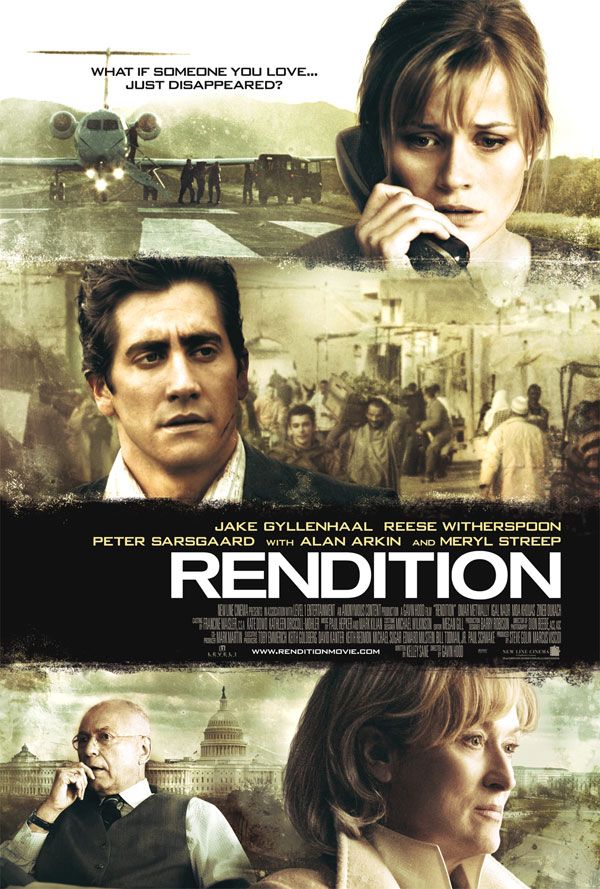 Why this film did not do better at the box office is beyond me. It had the star power: Reese Witherspoon, Jake Gyllenhaal, Meryl Streep, Alan Arkin, and Peter Sarsgaard- and directed by Gavin Hood (Tsotsi). It also had a decent story to tell, granted it might have gotten lost in the flood of political films dealing with terrorism and the war on terror. The film takes a simple story of an Egyptian who is taken in by the CIA coming back from a work related trip to South Africa due to connections he may have with a recent suicide bombing. Anwar El-Ibrahimi has lived most of his life in America and has made a life and family in the US. The story gets more complex as it weaves together the bureaucracy, cynicism and emotion that go into trying to figure the truth of the situation. Each character has their own perspective and political hide to look out for. And though it deals with torture, the film alludes rather than showing the horrendous nature of it.
See, in my day, a barber was more than just somebody who sit around in a FUBU shirt with his drawers hanging all out. In my day, a barber was a counselor. He was a fashion expert. A style coach. Pimp. Just general all-around hustler. But the problem with y'all cats today, is that you got no skill. No sense of history. And then, with a straight face, got the nerve to want to be somebody. Want somebody to respect you. But it takes respect to get respect. Understand? See, I'm old. But, Lord willing, I'd be spared the sight of seeing everything that we worked for flushed down the drain by someone who don't know no better or care.
 With the many films about the war in Iraq as a subtext coming out, this film could get lost as just another film trying to be political. In fact, this film rises above the simple "politics of now" and portrays the aftermath of war in a complex and compelling manner. While the plot is driven by Mike (Jonathan Tucker) status as AWOL and eventually discovered dead, the focus is on Hank Deerfield (Tommy Lee Jones) a retired Army man of a different era, on the search for his son. This generational difference becomes the major theme in the film, as Hank holds to the values of honor and courage, while the Army he witnesses through the friends of his Mike's colleagues, seem cynical, damaged, and lost. Who Hank is looking for becomes murky as relationships are in pieces, needing connection. Hank begins to connect through Detective Sanders (Charlize Theron) who decides she has nothing to lose, her respect on the job is at almost zero, and the two of them take up an informal investigation. She is a single mom, and the title of the film comes when Hank retells the story of David and Goliath to her son, who is lost to its meaning and significance. The investigation soon delves them deeply into the effects that war has on young people, who must not only adapt culturally, but also psychologically, to the trauma they are witness to. The film slowly draws out this story, making it a war film with very little action and violence. The film uses minimal dialogue but shows the power of war and the pain of those involved below the surface of the way we speak and how things appear on the outside.
 Who determines what is right or wrong? Or do we simply aim at what seems better? This is one of the central questions this film raises in the context of an old, but poor Boston neighborhood surrounding a case of kidnapping. Patrick (Casey Affleck) and Angie (Michelle Monaghan) live together and work together as private investigators, following people and looking for missing person's- usually for dead bodies. The McCready family approaches them to help in the police investigation to look for a missing four year-old. In order to not spoil the film I'll leave it there, but this deep and disturbing search leads to Patrick having to reflect on the morality, consequences, and responsibility of his choices and actions. In asking the question what is the right thing to do, we cannot merely explain our decisions as a reaction in our gut, or rely on platitudes, but rather the choices must become a lived reality- as painful and hard as the consequences might be. The characters are as complex as the plot as they all struggle with knowing what is right, and how to make choices in line with what they love.
  Inspired by the success of The Departed, this film pits two brothers who seem to be on opposite ends of justice against each other on the streets of New York. Bobby (Joaquin Phoenix), a club owner who keeps questionable company like the Russian mafia and drug peddlers is just trying to stay below the laws radar, while Joseph (Mark Wahlberg) is climbing the ranks toward his father's (Robert Duvall) likeness as chief of police. When the pressure mounts on Bobby, he has to find a way to get past his past, and make the moral choices necessary to love others, and decide who he really is. The film focuses on loyalty, and the tensions we find in life as many people and things contend for our loyalty.
 Another film about Elizabeth I. This film is a sort of sequel that deals with Elizabeth's later life when Spain attacked in order to bring England back to the Catholic faith. Cate Blanchett again stars as Elizabeth. This film also ties in a love story between Sir Walter Raleigh (Clive Owen) and Elizabeth's main attendant (Abbie Cornish). I think the film is alluding to the tension and hardship Elizabeth had to go through as she was committed to staying single for the good of the country, even while longing for companionship and love. The film maybe a little over dramatic as it gets a little near Braveheart in Elizabeth giving a moving battle speech, and the romantic arch seems somewhat over sentimentalized. Those viewers with a fetish for old costumes, castles, and cathedrals will have plenty to satisfy them.
 This film is more about raising awareness about the reality of the sex slave trade than a well acted or told story. Fortunately for the film raising awareness is a good thing and culturally relevant, unfortunately it makes for a sub par film. Written by Jose Rivera (The Motorcycle Diaries), this fictional (based on the 2004 NY Times article The Girls Next Door by Peter Landesman) story attempts to tie together four characters. A young Mexican girl, Adriana, who gets kidnapped and meets Veronica who has been captured from Poland through a immigration scam, and her brother who pursues her captures with Ray (Kevin Kline), a police officer from Texas who lost a daughter 10 years ago. This adventure takes all of them from the Mexico border through the states as they rendezvous in New Jersey for an internet action to sell Adriana. The film tries to be somewhat nuance by not having a happy ever after, but shows how the emotions that injustice incites can either free or ensnare us. The film ends with text on a black screen giving facts and quotes about the reality of the sex trade. To learn more about what you can do about this issue visit the films main page.
 Donkey Kong is a big deal! Ok, it's a bigger deal after seeing how much politics, egos, and competition there is for the all-time record score. This documentary follows Steve Wiebe adventure in gaming. Having been laid off of work in 2004, Wiebe decided to practice and aim for beating the 20+ year world record on Donkey Kong. What makes this film compelling is the characters that make up the intense subculture of video-gaming. What gives this seemingly innocent story interest and conflict is the dynamic and larger-than-life personality of Billy Mitchell. While he has gone on to start a hot-sauce empire, he continues to define himself by his original record, set in 1982, and his vast knowledge of gaming. The film hinges on the tension of a possible conspiracy to keep Mitchell's record safe in the hands of Twin Galaxies, which keeps the official records on video game records. A fun and informative film to watch, and you may find yourself entering a discussion on gaming that you couldn't even imagine.
 This is a reflective and contemplative film. Adapted for film from Alice Monro's short story "The Bear Came Over the Mountain" and directed by Sarah Polley, the story is about a coping with a relationship changed by Alzheimer's. Grant (Gordon Pinset) watches as his wife, Fiona (Julie Christie) starts to decline further into disease and eventually is institutionalized. As she forgets more and more she starts to care for a fellow patient and Grant has to deal with the pain of her unknowing. Like all stories of forgetfulness they causes the audience pause: why is memory so important to the human condition? Why is losing it so sad and painful? A film worth watching and reflecting on.
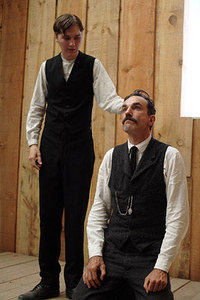 Apparently I didn't get the memo that I am not suppose to dislike this film, even just a little. I love P.T. Anderson, I can understand the comparisons to Robert Altman, especially his McCabe & Mrs. Miller, and Terrence Malick (Badlands, Days of Heaven, The Thin Red Line, and The New World), but this film ended up building to well...not anything like a complex or interesting story. The film is a character study of obsessive oil man Daniel Plainview (Daniel Day-Lewis). Most of the film is set after he moves north with his adopted son, and founds a new oil community there. The film also plays on the tensions between Daniel and the young pastor Eli (Paul Dano), who has his own psychological issues as a twin and religious fanatic. Similar to the book on which it is partly based, Upton Sinclair's Oil!, the story works as a critique of capitalism and the American Dream-it leaves one empty and alone. The problem is that this is not new to the audience, and the addition of the role of faith in this criticism is interesting but seems exaggerated. The cinematography is very good, and the score, written by Jonny Greenwood (of Radiohead) adds some eeriness and emotion to the film.
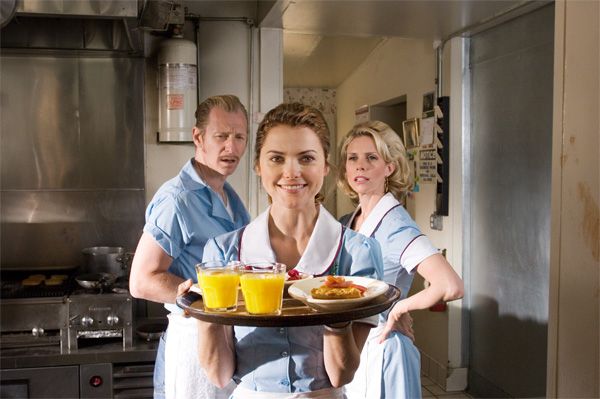 Add this film to the list of films about pregnancy released in 2007 (Knocked Up, Bella, Juno, 4 months, 3 weeks and 2 days). The main character here is Jenna (Keri Russell) She is a seasoned waitress in a small town whose passion is making pies at her job, but she has little control over her life. Her husband is very possessive, and Jenna hides her tips in an attempt to change her life by running away. In the process she falls for her gynecologist and shares her life with two quirky co-workers. In the end she discovers what she really loves- making pies. She learns that she does not need to depend on others to define her, rather she takes up her responsibility as a mother- her daughter depends on her. And she wants to start over and do things right. It is a romantic story, that is it stays away from being to realistic and is overly hopeful about the possibilities for Jenna (true or not I wouldn't know, but it seems somewhat unbelievable). Russell's acting is good, but the other characters seem to exaggerated.
 It would be easy to get taken in by the costumes and sets and assume that this is a historical epic love story set during WWII. Based on Ian McEwan's novel, this story is much more intriguing and reflective- playing with the assumptions of the genre. The ending of the film (which I won't spoil) was almost as mind-blowing as Fight Club. The story seems simple enough- young Briony (Saoirse Ronan) sees her older sister Cecilia (Keira Knightley) and what seems like an odd relationship to Robbie (James McAvoy), who has been taken in by the Tallis family and given an education- giving him some social mobility. Of course perception is not absolutely objective and each person has their story of the events and the "truth" about what is happening. The consequences are devastating and the film shows both the harsh reality of this, as well as the guilt and sought after atonement that starts to drive and motivate Briony. During the middle of the film I was beginning to feel as though the story had gotten side-tracked, but the final moments of this film drew it all together in a thought provoking way. I walked away loving this film and the conversation it helps initiate. The film is not only an intriguing story but asks question about how to tell a story, the truth of stories, and why it is that humans need, long, and do tell stories about the world and their experience in it. A good companion essay to this film is Tim O'Brien's How to Tell a True War Story (Full-Text). Worthy of its Golden Globe for Best Picture and a serious Oscar contender.
 Juno is ultimately a fun, and funny, film that rest on the humanness of the characters it portrays. Juno (Ellen Page) is a quirky junior in high school, who impulsively decides to have sex with her long time friend, Paulie Bleeker (Michael Cera). She soon discovers she is pregnant and then has to decide what is the responsible thing to do. She decides to give the child up for adoption by a nice suburban couple (Jennifer Garner and Jason Bateman). All of this is obviously a lot more complex than it sounds, especially for a young woman who is still discovering who she is. It isn't until the end of the film where the audience comes to really understand the fragility of being human and the devastating possibilities of things falling apart. But the films ends hopefully rather than cynically by showing that responsible decisions and real love are possible- even if they are hard work. This film follows in the recent trend started by Knocked Up and Superbad of telling a funny story that also illuminates lessons in being human. Some may be tempted to reduced this film down to the politics of abortion, but that would be missing the beauty and rich insight that this film provides.