

A controversial film about the Vietnam war adapting Joseph Conrad's Heart of Darkness as a story of war in the jungle rather than a trader's view of the Congo. After 3 hours and 20 minutes, I felt almost as crazy as the characters, it didn't help that I was tired. The view in the film is that the Vietnam war was useless and managed from afar rather than seeing the insanity it inflicted on those that fought. This is not the most interesting view of the Vietnam war, for some reading check out Tim O'Brien's The Things They Carried. The cinematography is really amazing, it definitely has the smell of hot napalm. The story of insanity in the jungle is told well, it shows the interaction that happens between people's character and the environments that influence and shape their actions.
July 05, 2005
Apocalypse Now - 5

The Rapture - 6
Michael Tolkin's first film (he wrote The Player - 6, Deep Impact - 5, and Changing Lanes). It is also an early, pre-X files, role for David Duchovny. The film deals with the idea of a world ending rapture well. It asks the challenging questions: Can actions really be forgiven? Is heaven (in the other worldly sense) an escapist belief? What does death mean? does it have meaning? Through out the film the main character, Sharon, is constantly trying to make sense our of her beliefs. In the end it she is asked the ultimate question, if the consequence is forever how would you choose, or is there really a choice? Of the small number of religious films I have seen this seems to deal with it the most honestly.
July 02, 2005
War of the Worlds - 6
This film is fundamentally about what humans will do to survive. The film will require some research on my part into what H.G. Wells story was about. My hunch is that Spielberg may have taken some liberties in this version. Although the narration at the beginning and the end of the film sounds like it came directly from the book. The struggle I had in watching the film was the question survival for what? The main character is a dead beat dad, played by Cruise, tries to save his two kids when all hell breaks loose, his is determined to reunite them with their mother. He uses everything at his disposal to survive. What is interesting is how dependent our culture is on technology, when all electricity is lost the people in the film have nothing to do, no stories to tell, books to read, or songs to sing that can comfort their fears. The fear of losing home has arrived and the hope of a family is all that can drive them to survive at whatever cost. There is some humor in the film but that is only to help the audience separate themselves from the events of the film, the humor is lost on the characters in the film. The best part of this film is that the audience can walk away with the opportunity to ask good questions about things that matter most. My fear is that the questions will be lost on most of the millions of viewers that this film will have this weekend.
June 30, 2005
American Graffiti - 7
This is a very postmodern film. It tells four stories around a common theme rather than one story with common characters. It was also billed as a musical since it focused a lot on the music of the era (none of the actors sing). It is more like contemporary storytelling than the stories of the 70's (George Lucas even mentions this in the extra features). It is a good look into the culture of the 60's and the high school "cruising" crowd. It is an entertaining film, with both some relationship drama and humor. It is hard to watch the actors (Richard Dreyfuss, Ron Howard, Harrison Ford, and Suzanne Somers) without thinking that they are old, since they have done many films since 1973 when this film was made. The underlying theme is how teenagers struggle with the tough decisions about planning out there futures. A Curt and Steve are wondering about going off to college and the good and the bad that may come of that decision. This is an original and interesting look.
The People vs. Larry Flynt - 5
This is the biography of Larry Flynt, the publisher and owner of Hustler Magazine. It portrays him as a hero for free speech, as he was involved in many court cases, culminating in his case with Jerry Falwell going to the Supreme Court. He was also shot while existing a courthouse which left him paralyzed from the waist down (He then develops a strange accent, maybe a minor acting/directing flaw). The film also shows part of his possible conversion to Christianity by Ruth Carter Stapleton, Jimmy Carter's sister. And his rejection of it after he is shot. This segment is the most confusing of the film because they leave the scenes short so the audience can only imply things rather than hearing it explicitly. Courtney Love does a good job of portraying Mrs. Flynt who became a drug addict and died of AIDS. Edward Norton is also good as Flynt's lawyer, Alan Isaacman. I'm not so sure he is the hero that he is portrayed as, but rather that he was more fanatical than most and gained a lot of publicity by it.
June 29, 2005
October Sky - 6
This is an inspiring film about where visions can take you. The film is the true story of Homer Hickam. He grew up in a coal mining town in the 50's and was inspired by the Sputnik satellite to design his own rockets. The story is really about the relationship of his friends and family, as well as the strain between his father's wishes and his own passion for rocketry. His teacher also plays a key part in encouraging his interests and helps him with the hard work of learning math and chemistry. It is a touching story about the hope for a different world, that requires showing grace and forgiveness, and the reality that people do indeed change.
June 27, 2005
Abre los ojos - 6
Open Your Eyes, is the original Spanish version of Vanilla Sky. Scene for scene it is almost exactly the same--Penelope Cruz plays the same character in both. I think I liked this one better in that it seems more original and the ending makes more sense than in the Hollywood version. Some of the dream sequences are shown with distortion so that you can actually get the perspective of Cesar, the main character. Sorry to spoil it for those who have seen neither, but the scene in which Cesar kills his lover is a lot more intense and shows his insanity better than Tom Cruise can pull off. The amazing thing about both films, and it's ultimate downfall is that it does not take into account that most people have the ability to doubt their perceptions rather than to doubt reality. If I think I have heard something wrongly, I usually ask the other person to repeat themselves. That seems like a better way to deal with reality than threatening to kill them because what they say doesn't seem to conform with my views of things. Overall, an interesting film that can engage people in conversations about perceptions and reality.
Die Weiße Rose - 7
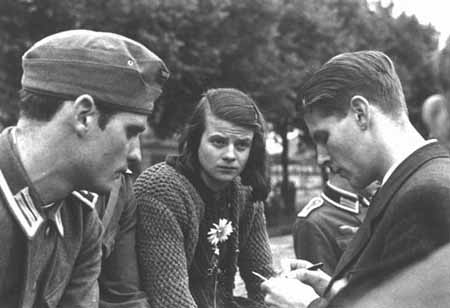
The White Rose is a German film made in 1982 about a group of German students who wrote and distributed The White Rose newsletter at Munich University during the middle part of WWII. Hans (left) and Sophie Scholl (center), and another student, Christoph Probst (right) were killed for treason in 1943. The court reversed the rulings after this film was released. There is a book by the same name with the original articles and some history by Hans and Sophie's sister, Inge. The film shows the resistance movement from within German. Most films about WWII are about surrounding countries resisting occupation. It makes this film distinct in that the characters had to make the hard choice to hope and work for their own government's and military's downfall. In the end, they were willing to die for their views. It is a challenging film. It helps the audience to think about their own civic responsibility, and how one's citizenship is an opportunity to do good and make positive change. To often the responsibility overwhelms us and we are likely to fall into apathy.
June 26, 2005
Elephant - 4
This is Gus Van Sant's fictional, but reminiscent, story of high school students who go on a shooting spree and kill a number of fellow students. The bulk of the film just shows what life is like for a few of the students, most of whom are the victims. All of the actors are actual high school students and most of them go by their own names. There isn't any way to talk about this film with out spoiling the ending, which I also heard about before actually watching the film, so there was the element of anticipation for when the shooting would start. The point of the movie is really to just show the complexity of logic and thought that are behind human behavior. It may initiate some conversation but is not really very enjoyable to watch.
Matchstick Men - 6
This is a good dramatic and funny film about a couple of con-artists. Like most of these types of film you start to like the characters even if you know what they are doing is criminal. This film involves a phobic con-artist who learns of his 14-year-old daughter and then starts to rethink his criminal ways. The film lets you try to justify coning people, you soon realize how much it hurtful it actually is. The film is fun to watch and keeps you guessing at every turn. Nicolas Cage and Alison Lohman do a superb job acting the parts.
June 25, 2005
Stand and Deliver - 6
This film is the true story of Jaime Escalante, who became a high school teacher and helps his failing students learn calculus and inspires them to value education. It does a good job of showing the assumptions that have shaped culture. Issues of race and school funding are part of the keys to understanding how amazing Escalante's methods of teaching were. The main issue come to a head when the ETS accuses the students of cheating (they all got the same questions wrong on the test). The students take the test again and do better on it the second time. At the end of the film it lists the number of students that passed the AP calculus exam. Escalante was able to change the perceptions that Hispanic students could not do well in math.
June 24, 2005
Crash (2004) - 7
This film is amazing. It was written by Paul Haggis, who also wrote Million Dollar Baby. It deals with the hard issues of race and the emotional intensity of anger that can accompany it. There are quite a few characters and stories that have similair themes and are brought together at the end of the film. It is an easy film to start conversation and dialogue about the issue of race in America and how that defines a lot of reality. The film gets at some of the complexity of racial issues by showing both the personal and some of the institutional ways that it effects people's behavior. It begs the question: How do you actively pursue good? Or, put differently, is it possible to do anything that is not racist? It seems as though perception is everything in our current culture. If this is the case then no real solutions to the problem seem to be with in our grasp. On the other hand, our perceptions often fail to tell us the truth, and the problem may lie in the inescapable human condition. The film implies that humanity is going to need something outside of itself if there is to be any hope for true flourishing as human beings. This film is challenging , but also gives hope that there are indeed miracles, which might be the only thing that keeps humanity from destroying itself.
June 23, 2005
Hard Eight - 6
This is P.T. Anderson's first film, which also goes by the name Sydney (his others are: Boogie Nights - 4, Magnolia - 7, and Punch-Drunk Love - 6). This film is about an older man, Sydney, who mentors a poor younger man named John in the art of gambling and wisdom of street smarts. The film keeps the story coming at you by strategically placed pieces of information. It allows for the first and last scene to be almost exactly the same while the audience has two different perceptions of it. As the story and characters develop the complexity of the situation turns Sydney's past actions from a sort of virtue into vice. The film seems to be a commentary on how situations play into decision making and ultimately the actions taken. The film also asks whether good ends or good means are better if one cannot do both in the given situation, which usually result form bad choices to begin with. It is not so much a moral tale as it is an insight into the human longing for healing relationships.
Boogie Nights - 4
This is a hard film to watch. It is about the pornography industry of the late 70's and early 80's. What makes it hard to watch is that the sexuality of the characters and there views of sex are so distorted and misdirected. The consequences are disastrous for life because sex has been robbed of its meaning, which means that the characters are confused as to the value of it apart from film. For one of the assistant directors, sex has meaning and he cannot live with the meaningless sex of others, which results in a killing spree-including himself. The film is also intense because it is hard to know how accurate a picture this is of some peoples views of sex. This film could also be used as a discussion point since it engages the issues of how culture influences these views and how it responds. In the end, though, it seems like a very sad view of reality.
June 21, 2005
Batman Begins - 7
Over the weekend, I saw this film in the theatre. I had relatively high expectations from the recommendations of friends, and I still walked away amazed at how well that they told this story and developed the characters. This film is not your typical superhero/comic book film (Bruce Wayne actually has no superhuman qualities or powers--like other superheroes, just a good martial artist and creative with technology). The theme of the movie, which is its driving force, is fear and the human responses and coping mechanisms for it. The characters are very well developed through out the film. This allows for the story to flow and for it to develop naturally. This also makes the story believable. I didn't come away from the film trying to think of minor flaws in logic like is the tendency after most movies about superheroes (Like the conversations in Mallrats and Chasing Amy). My only minor dislike of the film was Katie Holmes, who--at least in this film--really isn't that good of an actor. I think that the theme of fear allows the audience to ask good questions about what human fear is and how we fight it and can be controlled by it. This film definitely gets at aspect of what it means to be human. My hope is that this is the final Batman film, a sequel will most likely just revert the series back to the hero versus villain story that lacks the depth that this film has.
The Decalogue: VIII-X - 6
I have finally finished this 10-part series. This is a really good series that asks some interesting questions about all of life. Some of the stories are a little harder to understand how they fit with the commandments while others are really telling about how we might be able to interpret them in our own day. The final one about coveting is really pretty good, and the most humorous of the bunch. I would recommend watching at least a few of the episodes if not all of them--especially: 1, 5, 6, 7, and 10. Although being about laws, it avoids the legalism that is associated with it, which is probably the stories greatest features.
June 19, 2005
Tape - 7
This another film directed by Richard Linklater (This will be my last in my delving back into his filmmaking history), but the script was written by Stephen Belber (also wrote The Larmamie Project). The whole film takes place in a hotel room with three actors. The story and dialogue is amazing. It brings up issues of trust, friendship, blackmail, and ultimately is about how we perceive events and how we understand how others perceive and remember things. The acting is good, and the story takes many interesting turns that are both funny and serious. I think that it is a good film to help the audience understand their own perceptions and what that means for moral meaning--the everyday decisions that we make and the regrets and forgiveness that we look back on in our past.


